Event 1
Scott Carey’s exposure to the mysterious spray
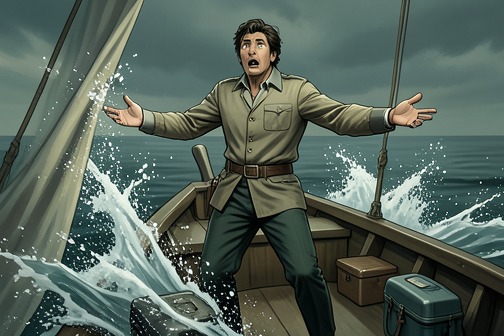
[Scott Carey’s exposure to the mysterious spray](entity:event-recall-event-scott-carey-s-exposure-c95ef0400ee6) is the story’s opening disturbance: a brief encounter that turns an ordinary day on a boat into an unexplained bodily event. Scott sees the spray coming, tries to avoid it, and fails; only after it has passed does he notice a sensation on his skin, leaving the episode at once physical and unresolved.
## Causes and Background
While Scott is sunbathing on top of the cabin, he happens to push himself up on one elbow and sees what first appears to be a tidal wave. Looking closer, he can see the sky and ocean through it: not a solid wall of water, but a curtain of spray rushing toward the boat. The mistaken first impression gives way to a strange, visible phenomenon whose origin is not explained in the scene.
Scott calls for his brother, [Marty](entity:character-recall-character-marty-5c0e5c16ff29), but gets no answer. He crosses the hot wood and runs around the cabin, trying to get clear of the approaching spray. The scene makes the exposure accidental rather than chosen: Scott recognizes a reason to avoid the spray, but has little time to act.
## The Exposure
Scott loses the race. One moment he is in sunlight; the next, the warm, glittering spray has soaked him. It passes quickly, sweeping across the water, and leaves sun-glowing drops covering his body. The sudden shift from dry sunlight to being drenched is the event’s decisive turn: the threat he tried to escape reaches him before he can get out of its way.
After the spray has gone, Scott twitches and looks down, noticing a curious tingling on his skin. He grabs a towel and dries himself. The sensation is not quite pain; it is described as a pleasant sting, like lotion on newly shaved cheeks. The distinction matters: his body registers the contact, but the immediate sensation offers no clear sign of injury or explanation.
## Immediate Aftermath and Significance
Once Scott is dry, the feeling has almost disappeared. He goes below, wakes Marty, and tells him about the curtain of spray that crossed the boat. The account comes after the event rather than as a warning that could help Scott avoid it; his brother hears about the encounter only once the spray is gone.
The episode establishes the spray as an unexplained exposure and gives it a modest but memorable physical trace: a temporary tingling that recedes before Scott can make sense of it. Its ordinary setting and fleeting sensation heighten the uncertainty. The scene records contact and its immediate aftermath, but supplies no cause or diagnosis.
Event 2
Scott Carey’s shrinking diagnosis
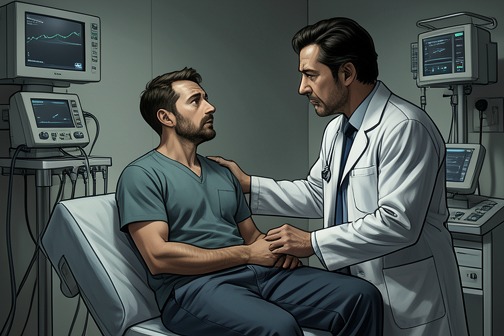
[Scott Carey’s shrinking diagnosis](entity:event-recall-event-scott-carey-s-shrinking-a4fd8421c4fd) converts a month of suspicion and medical testing into a confirmed physical crisis. The finding is both measurable and broader than a loss of height: Scott learns that every part of him appears to be shrinking proportionately, while the prospect of further hospitalization collides with work and financial obligations.
## Background and Investigation
The diagnosis follows a month of growing concern. Scott first visited [Dr. Branson](entity:character-recall-character-dr-branson-05a0b1b53cc8) after possible bowing of his legs or dropping of his arches was noticed. Dr. Branson initially attributed Scott’s weight loss to his trip and unfamiliar surroundings, setting aside the possibility that Scott was also losing height. As the days passed and Scott continued to grow shorter, suspicion gave way to repeated appointments and more extensive investigation.
Dr. Branson’s examinations included X-rays, blood tests, a bone survey for loss of bone mass, and a search for a pituitary tumour. Further X-rays accompanied a grave search for cancer. The accumulating tests mark the difference between an early explanation that treated Scott’s condition as weight loss and a later recognition that his whole body was changing.
## The Finding and Its Confirmation
When the diagnosis is spoken, [Louise Carey](entity:character-recall-character-louise-carey-d35b70c28bb0) cannot accept it at once. She had been about to call it impossible, but the word gives form to the dread she has carried through the month of appointments and tests. Her refusal does not undo the evidence: Scott tells her that Dr. Branson measured a loss of more than half an inch in height over four days and that the change affects every part of him proportionately.
Scott points to the comparison between X-rays taken four days apart and says that they confirm the change. The finding is not presented as a suspicion based on appearance alone; the paired images make his shrinking visible as a medical fact. Louise suggests that Dr. Branson could be wrong, but Scott’s own comparison with her makes the loss difficult to deny: once a six-footer, he now looks directly across into the eyes of his five-foot-eight wife.
## Consequences and Stakes
Confirmation does not bring an immediate treatment or an explanation for the cause. Instead, the discussion turns to the cost of the next step: Dr. Branson has said that Scott would need at least a month in hospital, away from work. Scott worries about asking [Marty](entity:character-recall-character-marty-5c0e5c16ff29) to keep paying his salary when he cannot work, and the prospect of bills weighs on him as heavily as the diagnosis itself.
Louise insists that Scott’s health must come first and believes Marty understands that. The exchange leaves the medical crisis joined to a domestic and economic one: treatment may require a prolonged absence from work, while the evidence of shrinking has already made the future uncertain. The diagnosis is decisive not because it resolves Scott’s condition, but because it replaces the possibility of change with proof.
Event 3
Scott Carey’s newspaper publicity and contract withdrawal
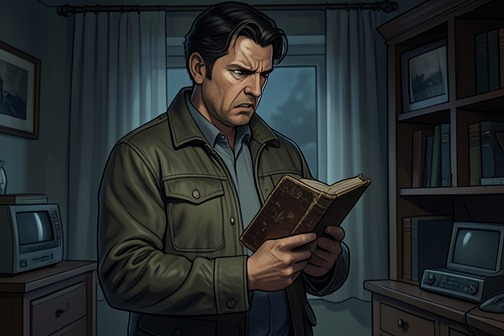
[Scott Carey’s newspaper publicity and contract withdrawal](entity:event-recall-event-scott-carey-s-newspaper-bf2d88a2a780) traces how a private affliction became a public story, and how Scott’s attempt to reclaim control came only after he had endured the exposure he first rejected. Recalled amid his isolation, the episode links the family’s financial strain to a publicity deal that brought unwanted attention and deepened his anger.
## The Story Reaches the Newspaper
The publicity began indirectly. [Marty](entity:character-recall-character-marty-5c0e5c16ff29) had mentioned Scott’s mysterious condition to a fellow club member, and the news spread into the city by degrees. [Mel Hammer](entity:character-recall-character-mel-hammer-9a4de502f0b4) then came to the apartment with an offer from the [New York Globe-Post](entity:organization-recall-organization-new-york-globe-p-8fe7269231fe). Scott later recognized the paper by the surviving letters on a damp, dust-covered copy he found near the refrigerator, an object that brought the earlier decision back into focus.
The offer arrived while the family was under considerable financial pressure. Although testing at the medical center had been free, they still faced a substantial bill for examinations, money owed to Marty, and other debts accumulated over a difficult winter. Winter clothes for the family, fuel oil, and additional medical expenses added to the burden after their move from [Los Angeles](entity:location-recall-location-los-angeles-11eff639bdf5). Scott nevertheless refused the offer at first, objecting to public curiosity and resenting that [Louise Carey](entity:character-recall-character-louise-carey-d35b70c28bb0) did not support his decision as strongly as he wanted. He recognized that his angry accusation against her was misplaced, but his fear and frustration fed an increasingly uncontrollable temper.
## Publicity and Its Costs
Scott eventually went ahead with the contract. The newspaper arranged photographs that showed him in shoes far too large, beside [Beth Carey](entity:character-recall-character-beth-carey-9e416f59f392) and Louise Carey, beside his old clothes, and next to a tape measure. One image included Hammer’s hand pointing to the mark corresponding to Scott’s former height. Doctors appointed by the paper examined him, and his case history was recounted for a readership of a million. The photographs and account turned the private facts of his shrinking into material for public consumption.
The attention expanded beyond the newspaper series. Offers arrived for radio, television, stage, and nightclub appearances, as well as magazine articles and syndication. People gathered outside the apartment, watched Scott, and asked for his autograph. Religious groups urged him to join their cults, while obscene letters also reached him. The publicity thus brought professional opportunities but also made his condition a spectacle, extending the intrusion into his home and daily life. Scott later remembered the experience as a source of intense anger and distress, including nights when he could not rest.
## Anger and Withdrawal
At the height of that anger, Scott drove to the city to tell the paper he was breaking the contract. He left in a state of hatred, an abrupt reversal of his earlier decision to continue with the arrangement despite his objections. The withdrawal marked an effort to refuse further exposure, but it followed the publication of his story and the attention that had already gathered around him.
The episode is recalled rather than presented as a continuous scene: the newspaper copy in the cellar prompts Scott to revisit the offer, his resistance, and his eventual participation. That retrospective structure places the public spectacle beside his present isolation. His contract dispute is not simply a rejection of publicity; it reveals the cost of having his condition converted into a story for strangers, even as the family’s debts had made the offer difficult to refuse.
Event 4
Scott’s climb to the refrigerator crackers
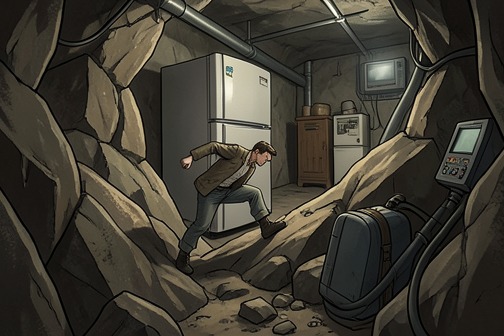
[Scott Carey](entity:character-recall-character-scott-carey-6772d18d7f70)’s climb to the refrigerator crackers is a survival ordeal in which the ordinary furnishings of [Carey's cellar](entity:location-recall-location-carey-04c8994a7bf8) become a landscape of cliffs, routes, and precarious footholds. Hunger forces Scott Carey to treat the enormous distance to food as a practical problem to solve, but reaching the [Cracker box](entity:object-recall-object-cracker-box-f88d5238d8b1) brings a second reversal: the crackers are water-damaged, and the prize of the ascent is only a limited supply of crumbs.
## The [Refrigerator](entity:object-recall-object-refrigerator-9aa39fbd9606) as a Distant Goal
The scale of the task is established before the climb begins. Scott Carey has completed the difficult climb up to the cellar floor and now faces a quarter-mile journey to the Refrigerator. The hose’s coils are hulking obstacles, the rake handle is as thick as a tree, and the Refrigerator rises like a ten-story building. Its top seems as remote as a mountain peak. The oil burner’s irregular ignition shakes the floor beneath him, a reminder that even the ground is not reliably still.
For a long moment, Scott Carey stands indecisively, staring at the Refrigerator’s white legs. Hunger ends his paralysis: he must reach the crackers or starve. The problem is not simply distance but route. He considers several possible ascents, involving a ladder, the fuel-oil tank, boxes, [Louise Carey](entity:character-recall-character-louise-carey-d35b70c28bb0)’s suitcase, a hanging rope, or the wicker table near the Refrigerator. Each offers a different sequence of hazards. The scene turns familiar household storage into terrain to be surveyed, and eating becomes the objective of an expedition.
## Building a Way Up
Scott Carey prepares a climbing aid from what is available. He draws [Thread](entity:object-recall-object-a5203909b9c8) from a carton, carries it back to the wicker table, and fetches a piece of wood from a log pile, breaking off a length from one log and fastening it to the Thread. The arrangement is small and improvised, but it gives him a way to make the table’s structure serve as a climbing route.
The first throw is comparatively easy because two narrow strips twist around the table’s main leg and flare toward its first shelf. Scott Carey aims the wooden piece at the gap where one strip juts away from the leg. On his third attempt, the wood passes through the opening; he carefully draws it back until it wedges between the leg and strip. Bracing his feet against the leg, he climbs while his body swings out at the end of the taut Thread. At the first stopping point, he hauls up the line, loosens the wooden bar, and prepares to use it again. Progress depends on repeatedly placing, securing, and recovering this makeshift equipment; each object must be handled as both tool and potential support.
The ascent culminates in a leap into open space. Scott Carey presses his lips together, whispers, “So be it,” and springs for the wooden bar. His arms strike it hard enough to become almost numb, and for a moment he believes he is falling. Instead, his arms close around the wood. He hangs above a tremendous void, gasping, with his legs swinging below him. After catching his breath, he turns carefully to face the next arrangement of supports, hauls himself into a sitting position, and rests, exhausted. The last step to the tabletop remains the hardest.
## The Cracker Box and Its Reversal
When Scott Carey reaches the open Cracker box, the expected reward disappears at a glance: the crackers are ruined. They are dirty, mouldy, and soaked through. He remembers the cause too late: directly overhead, the kitchen sink has a faulty drainpipe that lets water drip into the cellar whenever the sink is used. The crackers’ damage is not an abstract setback but the consequence of an unnoticed household defect, one that has turned the destination of his arduous climb into a spoiled supply.
The shock gives way to urgent salvage. Scott Carey kicks an opening through the heavy wax-paper lining and squeezes behind it, eating what he can and drinking drops of water clinging to the paper. He begins carrying dry crumbs out and piling them at the bottom of the box. To get back out, he tears handholds in the wax paper and climbs the improvised ladder, moving one or two crumbs at a time according to their size. He repeats the labor for an hour, then searches behind the lining for anything missed. The only remaining fragment is about the size of his little finger; he eats it while completing his circuit of the box.
## Hunger and the Measure of Success
The episode’s outcome is neither simple triumph nor total failure. Scott Carey has overcome the distance and danger separating him from food, but the food’s condition sharply limits what the climb has won. After surveying the wreckage, he estimates that his salvage amounts to only two days’ food; by Thursday, he will have none again. He pushes the thought aside and climbs out of the box, postponing the next crisis rather than solving it.
The Refrigerator and Cracker box change in significance as Scott Carey’s scale changes. They are household objects in ordinary use, yet here their height, surfaces, contents, and defects govern whether he can eat. His improvised Thread and wooden bar make the cellar’s furnishings temporarily usable, while the leaking drainpipe reveals how an unnoticed fault can undo the value of an entire ascent. The climb therefore measures survival not by reaching a destination alone, but by what remains available after the effort: a few crumbs, a short reprieve, and another deadline already approaching.
Event 5
Scott’s confrontation with the black widow
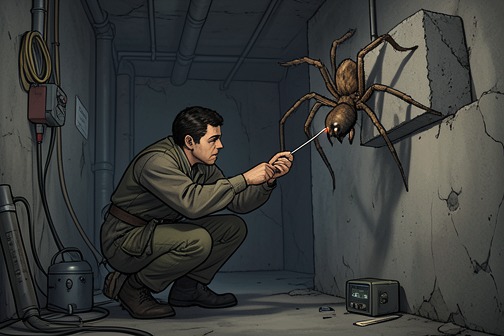
[Scott Carey](entity:character-recall-character-scott-carey-6772d18d7f70)’s confrontation with the black widow turns an exhausting food haul into a fight for survival. When the spider blocks his way back to shelter, he escapes into the cellar’s passages; later, trapped without room to flee, he turns a sewing pin into a weapon and forces the predator back.
## The Ambush and Improvised Weapon
After dragging his heavy bundle of food across the cellar, Scott reaches the foot of a cement block. The giant spider is waiting along its top edge. He freezes beneath it, then bolts into one of the passages cut through the block as the spider drops behind him. The attack converts the food that promised warmth and comfort into the cause of an immediate crisis: Scott must escape before he can reach his bed.
The pursuit leaves him among clothes with no clear opening. As the spider clambers over his legs, Scott falls into an open sewing box and finds a pin. He grips it with both hands and drives it toward the spider’s belly as it leaps. The creature springs off the point, rushes him again, and meets the pin a second time; one of its legs rakes the skin from his temple. Scott cries, “Die! Die! Die!” but the spider survives and leaps at him once more. The pin does not kill it, yet its point makes the predator recoil, giving Scott a chance to hold his ground.
## A Victory That Does Not End the Danger
The [Black widow spider](entity:creature-recall-creature-91703d2c1252) finally scuttles backward, and Scott Carey remains crouched with the pin leveled at it until the creature disappears into the shadows. He cannot tell how long he holds his position; the change from confrontation to stillness seems almost imperceptible. When the oil burner roars into life, he whirls around, still expecting an attack, and circles for a long time before realizing the Black widow spider has gone.
Relief arrives with exhaustion. The pin slips from Scott’s hands and clatters onto the wooden bottom of the box; his legs give way, and he sinks into a heap against the weapon that has saved his life. But the reprieve is incomplete: the Black widow spider is alive, and it might be waiting outside the box or beneath the water heater. Scott recognizes that he cannot carry the heavy pin everywhere, and soon may not be able to lift it at all. The immediate victory leaves the larger dangers intact: dwindling food, increasingly difficult access to water, the need to keep altering his clothes, and no way out of the cellar. Over all of them hangs his dread of what will happen between Saturday night and Sunday morning.
## The Pin as a Temporary Equalizer
Scott’s defense depends on keeping the point between himself and the spider, not on overpowering it. Braced on his left knee, with his right leg set behind him and the pinhead held against his hip, he withstands another rush; a spiny leg has already torn the skin at his temple. When the Black widow spider touches the point and retreats, Scott stays rigidly crouched, the heavy pin wavering but still aimed. The weapon changes the terms of the encounter for a moment: the spider can be made to draw back, though neither its survival nor Scott’s injured, exhausted body permits that narrow advantage to become security.
## The Fragility of Survival
Before the spider appears, the food haul briefly restores a sense of purpose: Scott’s effort is animated by the prospect of food, water, and warmth, and by the conviction that life remains worth struggling for. The attack breaks that small assurance without resolving the needs that produced it. In this reversal, the confrontation measures survival not as a single victory but as a precarious succession of bodily necessities and threats.
Event 6
Scott’s thwarted escape from the cellar
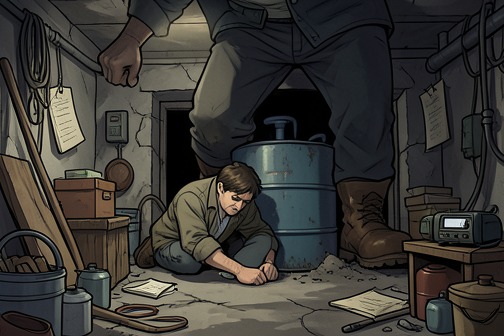
[Scott Carey](entity:character-recall-character-scott-carey-6772d18d7f70)’s thwarted escape from Carey’s cellar is a hard-won attempt at freedom that ends where it began: beneath a closed door, injured and depleted. A giant’s arrival makes the cellar’s scale newly terrifying, and Scott’s effort to climb its seven enormous steps brings him into the path of the [House cat](entity:creature-recall-creature-bd0cbfb4fc38). He survives through improvisation and desperate movement, but neither the stairs nor the rock shelter offers a way out.
## The giant and the scale of escape
Scott has just measured himself at the ruler and is walking toward the water heater when a loud creak and thunderous crash announce a giant descending the cellar steps. A wide carpet of sunlight falls across the floor. Scott freezes at the sight, struck both by the figure’s immense size and by the recognition that he himself was once that size. The giant’s shoes rise above Scott’s head and land with enough force to shake the floor. The encounter makes the change in scale physical: what had been a familiar domestic space now contains a being whose ordinary movements could crush him.
Scott first keeps close to the side of a block, then runs beneath the fuel tank and tables while the giant examines the water-heater machinery. He reaches the foot of the stairs, where the first step rises fifty feet above him. The cellar door is visible in the sunlight overhead, but the steps are not a simple staircase at his scale; each is a sheer face, and seven stand between him and the back yard. At the far end of the first step, Scott finds a narrow, three-sided channel in the mortar between cement blocks. He judges that he might climb it by bracing his back against one side and his sandal bottoms against the other, inching upward through leg tension. The route is possible in principle but punishing, with six more such faces waiting beyond the first.
## A precarious climb interrupted
Scott retrieves a length of [Thread](entity:object-recall-object-a5203909b9c8) and a bar from the wicker table, hoping to make a climbing aid. The bar cannot reach the top of the step, and the narrow channel offers no crevice in which to lodge it. He turns instead to a piece of straw, tests it, and begins climbing with the Thread coiled over his shoulder. The straw sags beneath his weight and once slips sideways; he has to stop and jerk it back into position. He climbs with his legs wrapped around it, concentrating on the cement face and planning to lower a Thread loop from the top and pull the straw up after him.
When he has climbed some thirty feet, a huge shape passes over him and blots out the sun. The House cat has found him. Scott nearly loses his hold, then clings to the underside of the straw and stares into its green eyes. The cat edges nearer in wary curiosity, its body low and its whiskers twitching. Its breath reaches him as he hangs above the floor. The pause turns the climb into a trap: Scott is suspended on an unstable makeshift ladder, with the cat’s immense paw rising toward him and no safe ground immediately within reach.
## Flight into the rocks
At the last moment Scott shouts at the cat and throws the straw aside. It slides down the cement face, and he hangs on until it is close enough to the floor for him to leap. He lands in a somersault and struggles back to his feet as the cat advances. When its paws crash down on either side of him, its claws scrape sparks from the cement. Scott throws the coil of Thread into its open mouth. The cat recoils, spitting and gagging, giving him the instant he needs to push off from the step and dive into a hole among the stones.
The refuge is only temporary. The cat’s paw rakes the place where Scott entered, and a stone rattles away. Then the giant begins moving the boulders while calling for the cat. Light suddenly cuts into the cavity, and Scott dives into a newly opened tunnel. He falls seven feet onto a rock shelf, scraping his right arm; a boulder lands beside him and tears the skin of his right hand. As the giant continues opening the stones, Scott runs through the darkness. Rocks bounce across the floor, knocking him down and driving him into a wall. The escape attempt has become a flight through a collapsing, unfamiliar passage, with the giant’s search following close behind.
## Back in the cellar
Scott eventually stumbles out at the cave mouth. The giant and the House cat are gone, the side of the water heater has been fastened back in place, and the cellar has returned to its former stillness. The door remains shut. From the rocks he looks toward the steps, but the route that briefly seemed climbable has yielded neither an exit nor relief. He is sore throughout his body, bleeding, weak, and unsure whether he is starving or nauseated; his headache throbs and his hands shake.
The small remaining amount of water in the [Thimble](entity:object-recall-object-thimble-db81f3be1ef8) has been knocked onto its side. Scott drinks the drops from its cup-like hollows, swallowing painfully. The ending reduces the failed escape to its starkest consequences: a distant door he cannot reach, a shelter that exposed him to further danger, and a few drops of water to sustain him. His resourcefulness has kept him alive through the encounter, but it has not changed his confinement.
Event 7
Scott is attacked by teenagers at the lake
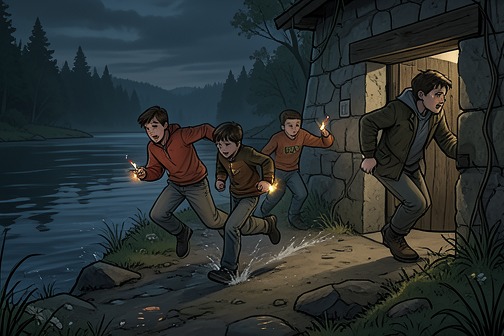
[Scott is attacked by teenagers at the lake](entity:event-recall-event-scott-3a16be05eaaf) when a chance encounter turns his increasingly exposed public identity into a direct physical threat. Three boys approach while singing, pursue him despite his refusal to run, and mock him after recognizing him as the shrinking man. Scott escapes their hold and reaches shelter in a cellar, but the incident ends not in safety restored so much as in a silence he carries home to [Louise Carey](entity:character-recall-character-louise-carey-d35b70c28bb0).
## Encounter and Pursuit
Before the boys catch up with him, Scott hears their youthful voices singing as they walk nearby. Their song concerns being lost, but Scott’s attention turns to the ordinary passage into adulthood that the boys seem to take for granted. He watches with envy: they are growing up in bodies that do not impose the same restrictions on them. This contrast makes the encounter more than a random interruption. Scott is already acutely aware of his isolation, and the boys’ easy movement through the night sharpens that awareness before they have even addressed him.
Scott recognizes the situation as a race as he heads toward the sidewalk, but refuses to run from three boys. They gain on him, and the glow of their cigarettes marks their approach. One grabs his arm before he can reach the sidewalk. Scott tells them to let him go, but his protest does not end their hold. The encounter quickly shifts from pursuit to a confrontation in which his small stature leaves him physically outmatched.
## Recognition and Threat
At first, the boys treat Scott as an unfamiliar and apparently younger figure. A match briefly illuminates his face, and one of them realizes that he is not a child but the publicly known shrinking man. Recognition changes the terms of the encounter: the boys now address him as a spectacle, not as someone entitled to ordinary consideration. Their laughter and taunts make his condition the basis for treating him as less than a person.
The boys threaten to humiliate him and move to take his wallet. Scott offers them his money, trying to buy time rather than persuade them to behave reasonably. He understands that argument will not stop them. The passage attributes their violence to anger at their world, which they can express only through violence; it does not present the attack as a considered grievance against Scott. Their recognition gives the scene a cruel irony: the publicity that makes Scott identifiable also makes his vulnerability legible to strangers who choose to exploit it.
## Resistance and Escape
Although held by the boys, Scott continues to resist. He surges forward when they threaten him, and when an opening comes he kicks one of them and pulls himself over a fence. The action does not make him stronger than his attackers; it gives him a chance to break their hold. He drops to the other side and runs on, limping, while the boys regroup behind him. His escape is therefore narrow and costly, achieved through a sudden physical effort rather than through help or negotiation.
Scott reaches the next street and finds a cellar door open. He slips down the steps, turns, and pulls the heavy door shut. In doing so he reaches a place where the boys cannot immediately follow, but the refuge is difficult to enter and leaves him too weak to rise at once. He sits on the cellar steps, chilled and exhausted, then begins to cry. The narration describes this despair through the image of a frightened child alone in an unloving place, reversing the boys’ insistence on seeing him as a freak: beneath the public label is a person who has been hurt and frightened.
## Return and Aftermath
Later, once it is safe, Scott limps home, chilled to the bone. Louise Carey is frightened and puts him to bed, repeatedly asking what has happened. Scott does not answer. Instead, he keeps shaking his head on the pillow. The return home does not bring an account of the attack or a conversation that could make it intelligible to her; his expressionless silence becomes the immediate aftermath of the violence.
The episode joins two forms of exposure. In public, Scott is recognized and reduced to the spectacle of his shrinking body; in private, he cannot bring himself to tell Louise Carey what the boys did. His effort to escape is real, but it does not undo the humiliation or restore his ability to move through the world without being singled out. The scene’s turn from the boys’ casual singing to Scott’s wordless return makes the distance between ordinary youthful freedom and his precarious existence concrete, while leaving the consequences largely inside his silence.
Event 8
Scott's progressive shrinking
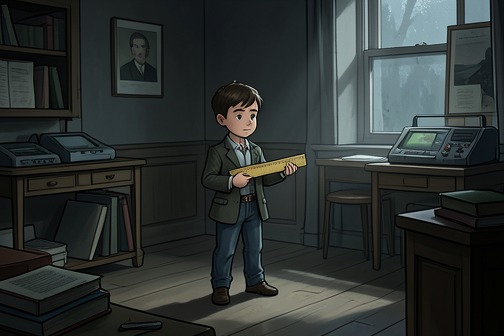
[Scott's progressive shrinking](entity:event-recall-event-f144667f57c6) is the bodily crisis at the center of his story: a gradual, measurable change eventually explained as the delayed effect of a poison that interferes with growth rather than destroying the pituitary gland. Its slow course links a rare environmental exposure to a medical mystery, then makes the abstract diagnosis immediate in the cellar, where Scott discovers he is only two-sevenths of an inch tall.
## Medical Findings and Cause
Testing rules out acromicria, the condition initially suspected, and finds no pituitary disease. Urinary tests instead reveal a negative nitrogen balance: Scott's body is excreting more nitrogen than it retains, depriving it of a major building block. An imbalance in creatinine adds to the process, while phosphorus and calcium are also being lost in proportions corresponding to their presence in his bones.
The investigation identifies an insecticide spray altered by radiation. The exposure depends on an exceptionally unlikely combination: a particular amount of insecticide and radiation, received in a particular sequence and at particular times. The radiation quickly dissipates; the poison remains. It does not destroy the pituitary gland, but progressively undermines its ability to maintain growth.
## How the [Shrinking](entity:concept-recall-concept-shrinking-573d46216e37) Proceeds
The poison drives nitrogen into excess waste and disrupts the body's handling of creatinine, phosphorus, and calcium. As calcium and phosphorus are lost, Scott's bones lose their mineral content and can contract. Hormone extracts cannot correct the process because the poison also produces an opposing antihormone action. The explanation therefore accounts not only for Scott's shrinking, but also for why an apparently relevant treatment fails to reverse it.
The diagnosis does not bring an immediate cure. Because the toxin can be fought only with an antitoxin, Scott is sent home while one is sought. His shrinking thus continues during a period of waiting: the cause has been identified, but the remedy remains unavailable. The gap between medical understanding and effective treatment turns the condition into an ongoing ordeal rather than a resolved diagnostic puzzle.
## The Cellar and the Measured Change
Later, in the cellar, Scott wakes after sleeping through a period when he had considered ending his life. He does not interpret the sleep as proof of a will to live; he recognizes only that he had not been able to will himself to die. As he struggles out from beneath the cardboard shelter, its increased heaviness confirms what he had meant to check against the ruler: overnight he has shrunk another fraction and is now two-sevenths of an inch tall.
Scott does not measure himself again. At that scale, the ruler has ceased to offer a useful purpose, and he crosses the floor unsteadily toward the hose. The discovery gives the medically described process a stark physical consequence: shrinking is not a past exposure or a diagnosis confined to a clinic, but a continuing change that alters his body and the practical terms of surviving in the cellar.
Event 9
Discovery of the cause of the shrinking
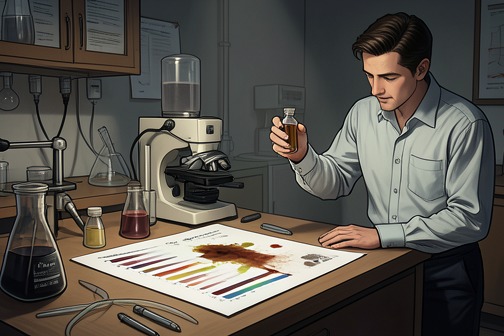
The discovery of the cause of the shrinking turns [Scott Carey](entity:character-recall-character-scott-carey-6772d18d7f70)’s unexplained physical change into a specific, if extraordinarily unlikely, chain of exposure and biological effects. Laboratory analysis finds a new toxin in his system; questions about his past bring back a boat-spray incident; and the investigators conclude that radiation had transformed insecticide into a poison that steadily undermined his body’s capacity to maintain growth. Identifying the cause explains the process, but does not itself provide a cure.
## The Investigation
The discovery emerges from a sustained medical search rather than a single obvious sign. Paper chromatography separates elements in Scott Carey’s body as they travel across paper, with each element staining a different area according to its specific gravity. The analysis reveals a new element in his system, identified as a new toxin. That finding changes the investigation’s direction: the problem is no longer only how to counteract the growth extract, but what substance is opposing it and where that substance came from.
The questions put to Scott Carey move from possibilities that can be ruled out toward an exposure he has not yet recalled. He is asked whether he encountered germ spray, including bacterial warfare, and then whether he was accidentally sprayed with a large amount of insecticide. At first, he has no clear memory to offer; the possibility produces only diffuse apprehension. The account thus presents recognition as delayed: the relevant experience is part of his past, but it does not initially appear in his mind as an explanation for his present condition.
## Recalled Exposures
The first memory concerns [Los Angeles](entity:location-recall-location-los-angeles-11eff639bdf5), on a Saturday afternoon in July. Scott Carey had left home to go to a store and was walking through a tree-lined alley between rows of houses when a city truck turned in to spray the trees. The mist reached him, and he shouted at the driver. This incident gives the investigators a plausible exposure to insecticide, but they tell him it cannot, by itself, account for the shrinking. It is only the beginning of the explanation, not its solution.
As questioning continues, Scott Carey recalls a separate afternoon aboard a boat. Spray had washed over him there as well. This memory supplies the missing element: the boat spray had been impregnated with radiation. The two episodes therefore do not have interchangeable significance. The Los Angeles encounter establishes an earlier contact with ordinary insecticide, while the later boat incident brings the investigation to the exposure capable of explaining why the substance acted so abnormally. The cause becomes legible only when Scott Carey’s recollections are set beside the laboratory finding.
## The Cause and Its Mechanism
The investigators identify the poison as insect spray hideously altered by radiation. The account stresses the exceptional conjunction required: a particular amount of insecticide and a particular amount of radiation had to reach Scott Carey’s system in a particular sequence and at a particular time. It is described as a one-in-a-million chance. The radiation dissipated quickly and became unnoticeable; the poison remained. That contrast helps explain why the cause was difficult to recognize: the exposure’s most unusual component left no continuing visible presence, while its effects persisted in the body.
The toxin did not destroy the pituitary gland. Instead, it progressively impaired the gland’s ability to maintain growth. The distinction matters to the explanation: the gland remains, but the process it regulates is steadily compromised. The poison also forces Scott Carey’s system to convert nitrogen into excess waste, and it affects creatinine, phosphorus, and calcium, leaving them to be discharged rather than retained in their normal role in the body.
The account connects those changes to the physical shrinking through the bones. As the poison decalcifies them, they become soft and pliant, able to shrink little by little. Meanwhile, administered hormone extract cannot reverse the process: the poison provokes antihormone action in direct opposition to the treatment. The shrinking is therefore not described as a sudden transformation or an isolated failure of one remedy. It is a continuing process driven by several connected effects, while the body’s attempted hormonal support is actively countered.
## Consequences of the Discovery
Finding the toxin closes the search for what caused Scott Carey’s condition, but it leaves the practical question of treatment open. The investigators conclude that a toxin can be fought only with an antitoxin, and they send him home while they search for one that might save him. The discovery is consequently both an answer and a deferral: it gives the shrinking a causal account, but no immediate means of stopping it.
The wait for an antitoxin becomes a new interval of uncertainty. Scott Carey rents a post-office box so he can receive two or three deliveries a day instead of one, and makes repeated trips there for news. The routine gives the medical search a daily measure: although the cause has been identified, the possibility of treatment remains dependent on a remedy not yet found. In that sense, the explanation does not end the crisis. It clarifies what has happened to his body while leaving its future unresolved.
Event 10
Treatment for the shrinking disease fails
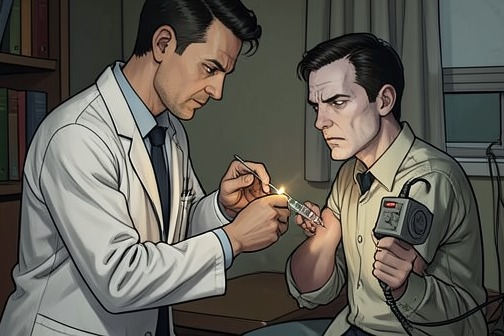
The treatment failures mark the point at which medical explanation and medical rescue separate in [Scott Carey](entity:character-recall-character-scott-carey-6772d18d7f70)’s illness: clinicians identify a process that is progressively undermining his body, but neither hormone treatment nor the later antitoxin can stop it. Each unsuccessful intervention narrows the hope attached to a different account of the disease, until understanding its cause offers no assurance of a cure.
## Early treatment attempts
The medical team first tries ACTH, possibly to check the catabolic breakdown of tissue. It has no effect. The failure is significant because the treatment is directed at a process already visible in Scott’s changing chemistry: his body is losing the capacity to maintain growth, while creatinine, phosphorus, and calcium are being displaced into waste. The doctors’ approach is medical and experimental, but the treatment does not interrupt the decline.
They then consider pituitary extract. The proposed benefit is specific: it might help Scott retain nitrogen and form new protein. The doctors also recognize the uncertainty of administering growth hormone to a human patient. The response cannot be reliably predicted, and even the best extracts may be poorly tolerated or produce abnormal results. Scott asks to receive the treatment despite those risks, reasoning that he cannot be worse off. The extract is administered, but the result is negative. Something in his system is acting against it.
The two failed approaches expose a limit in treating the illness as a simple shortage of growth hormone. Adding a substance associated with growth cannot overcome a disease process that is actively opposing its effects. The failure is not merely the absence of improvement: it directs attention toward an unidentified cause that is interfering with the body’s response.
## Diagnosis without a remedy
The search for that cause depends on a sequence of questions and tests rather than a single early insight. Paper chromatography reveals a new toxin in Scott’s system. When the clinicians ask whether he has encountered germ spray or insecticide, he initially cannot recall the relevant events. He then remembers being sprayed by a city truck in a tree-lined alley in [Los Angeles](entity:location-recall-location-los-angeles-11eff639bdf5), where the mist burned his skin and stung his eyes. The doctors tell him that this incident alone is not the full explanation; something had transformed the insecticide into a much more damaging poison.
A second recollection supplies the missing link. On a boat, Scott had been caught in a curtain of spray that crossed the water. He had tried to avoid it, lost the race, and was soaked. Afterwards he noticed a tingling on his skin. The later investigation identifies the spray as insecticide altered by radiation. The explanation depends on the conjunction of the two exposures and their sequence: the radiation dissipated, while the poison remained. The diagnosis thus gives the treatment problem a more precise target, but it also reveals why the hormonal attempts have failed.
The toxin has not destroyed the pituitary gland outright. Instead, it has progressively damaged the gland’s ability to maintain growth, altered the handling of nitrogen and other elements, and softened the bones by removing calcium. It also produces antihormone action that directly opposes administered extracts. These findings explain the negative response to pituitary treatment, but they do not yet provide an antidote. The medical search has found a cause and a mechanism; it has not found a way to reverse either.
## Antitoxin and continued decline
Once the toxin is understood, the remaining strategy is to find an antitoxin. Scott is sent home while the search continues, leaving him to wait for news that could determine whether the explanation has practical value. The waiting becomes part of the ordeal of treatment: he rents a post-office box so that he can receive more frequent deliveries and repeatedly checks for communication from the medical centre. The prospect of a remedy remains present, but it is not yet available to him.
The antitoxin is eventually discovered and administered to Scott three times. It does not work. In retrospect, he remembers this month of treatment as one more failed attempt, but by then exhaustion has changed the way the failure registers. Under the box lid in the cellar, with the spider still nearby and water in the hose, he is too depleted for the memory to provoke the earlier intensity of fear. He considers waiting for the spider to leave and then walking over the cellar cliff, an intention shaped by his immediate exhaustion rather than a successful medical outcome. The antitoxin’s failure closes the last hope represented by that particular treatment.
## Consequences and significance
Later, speaking with [Clarice](entity:character-recall-character-clarice-4610eb332d49), Scott acknowledges that he is incurable. He also recognizes that fear of learning this had contributed to his earlier departure from the doctors before testing was complete. His acceptance does not mean that he has decided to give up; he distinguishes ending the struggle against what cannot be beaten from abandoning life. That distinction follows a course in which each treatment failure has removed a possible means of control without erasing his capacity to choose how he meets the disease.
The episode’s central reversal is therefore not from sickness to recovery, but from diagnosis as promise to diagnosis as limit. Chromatography identifies the toxin; the exposure history explains its origin; the antihormone action accounts for the failure of pituitary extract; and the later antitoxin injections fail to change the outcome. The accumulating knowledge makes the disease more intelligible while leaving Scott’s shrinking unchecked. Treatment fails not because the illness remains wholly mysterious, but because discovering how it works does not provide an effective means of stopping it.
Event 11
Scott is locked in the cellar
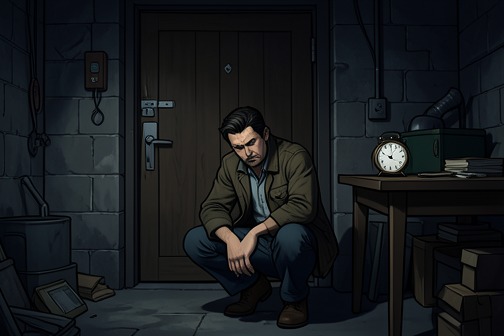
[Scott Carey](entity:character-recall-character-scott-carey-6772d18d7f70) is locked in [Carey's cellar](entity:location-recall-location-carey-04c8994a7bf8) when [Louise Carey](entity:character-recall-character-louise-carey-d35b70c28bb0) returns to work and arranges for a neighborhood girl to watch [Beth Carey](entity:character-recall-character-beth-carey-9e416f59f392). The confinement is presented as a solution to an immediate domestic problem: Scott is too small to care for Beth and cannot pass as an ordinary child. But the arrangement also makes him a secret to be hidden from the person entering the household, and the closing lock transforms an accommodation into imprisonment. His reluctant acceptance gives way to terror as the door shuts and the sounds of the routine begin to take shape in his mind.
## Background and Cause
The arrangement follows the end of summer, when the teenage girl who had worked at the lake grocery store returns to school. Louise, who had applied for the opening a month earlier, takes the job. She had vaguely assumed Scott could look after Beth while she worked, but his height—barely reaching Beth’s chest—makes that plan untenable. Scott also refuses to try. Louise therefore hires a neighborhood girl who has left high school to care for Beth, despite recognizing that the added expense will leave the household with little money.
The babysitter’s presence creates a problem beyond childcare. Louise tells Scott he will have to remain in the cellar during the day unless he wants the girl to learn who he is; his appearance cannot plausibly be mistaken for a child. The threat of discovery, rather than any stated danger from the girl, drives the decision. Scott’s silence and shrugging shoulders do not resolve the disagreement: they register his withdrawal while leaving Louise to make arrangements around his condition.
## The Cellar Arrangement
After breakfast, Louise accompanies Scott downstairs and brings a lawn chair for him to sit on. Between the fuel tank and the refrigerator, she retrieves a suitcase from a pile of boxes and puts two chair cushions inside it, preparing a place where he can nap. The details make the plan tangible: the cellar is not merely a place he must visit, but a daytime enclosure being fitted out for his use. Scott calls the proposed sleeping place a degrading comparison, while Louise treats it as a practical provision.
The question of the door makes the difference in their understanding explicit. Louise worries that the girl might be nosy and considers putting the lock on. Scott refuses, insisting that he does not want the door locked. Later, after drinking his coffee while the girl walks around upstairs, he tells Louise to go ahead and lock him in. Her answer recalls that this was his decision and asks whether he wants to risk being found. His change of position is not presented as comfort or agreement; it is a concession to the alternatives Louise has laid out.
## The Door Closes
At their parting, Louise kisses Scott on the top of the head. He draws away, and she goes up the steps. Left on the cellar floor, he rhythmically slaps folded newspapers against his leg and imagines the pattern that will recur every day: sandwiches and coffee below, a farewell kiss, Louise leaving, the door descending, and the lock snapping shut. The sequence reduces domestic care to a repeated timetable while placing Scott on the confined side of each departure.
When the lock actually snaps, the anticipated routine becomes an immediate crisis. Scott feels a surge of terror, nearly screams, sees Louise’s moving legs, and presses his lips together to suppress the cry. He understands himself as a prisoner and as a monster hidden by decent people so the world will not learn the secret. The language marks the emotional reversal: a plan he has accepted under pressure becomes a sentence he experiences as exclusion and captivity. After the fear subsides, passive withdrawal returns. He climbs onto the chair, lights a cigarette, drinks coffee, and thumbs through the previous evening’s [New York Globe-Post](entity:organization-recall-organization-new-york-globe-p-8fe7269231fe).
## Secrecy and Aftermath
The newspaper makes the cellar’s isolation part of a wider public absence. On page three, a short article asks where the shrinking man is and reports that Scott disappeared three months earlier, with no word received from any quarter since. The report does not explain how he came to be concealed in the cellar; instead, its public uncertainty stands against the private fact of his confinement. He is physically present in the household yet absent from the account of the outside world.
The episode’s force lies in this collision between ordinary household logistics and Scott’s altered status. Louise must work, Beth needs care, and the babysitter must not discover him; each practical fact narrows the available choices. Yet the cellar arrangement exacts more than privacy. Its repeated farewells, locked door, and hidden occupant turn the family home into a boundary between those who can move freely upstairs and Scott, whose survival now includes remaining unseen. The newspaper’s unanswered question sharpens that separation: while the world wonders where he has gone, he sits below it, reading about his own disappearance.
Event 12
Scott's spying on Catherine is discovered
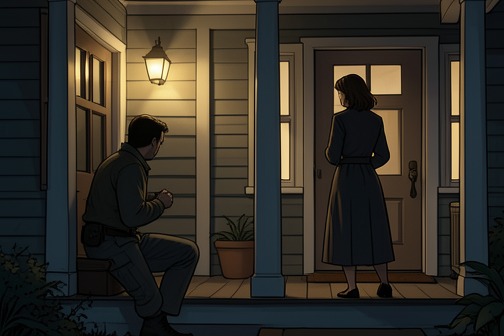
[Scott's spying on Catherine is discovered](entity:event-recall-event-63fde9fb935c) when a slip on the porch interrupts a routine he has built around secrecy, timing, and access to the house's windows. The incident turns his private fixation into a visible breach: [Catherine](entity:character-recall-character-catherine-48275454cf20) hears him, sees him flee, and leaves him hiding outside while he anticipates [Louise Carey](entity:character-recall-character-louise-carey-d35b70c28bb0)'s response.
## The Routine Behind the Incident
Scott's surveillance takes shape during his confinement in the cellar. Books can occupy him briefly, but his thoughts repeatedly return to Catherine, and he finds it difficult to remain absorbed in reading. The cellar is both a place where Louise Carey expects him to stay and a base from which he can still reach the outside. Because the windows are not secured against his leaving, the possibility of watching Catherine remains open, making the restriction incomplete and intensifying his preoccupation.
Scott brings a small clock downstairs, telling Louise Carey that it will help him keep track of time. In practice, he uses it to estimate when [Beth Carey](entity:character-recall-character-beth-carey-9e416f59f392) is napping, so that he can leave the cellar and look through the house's windows. The difference between his stated reason and his actual purpose makes the clock part of a private schedule: an ordinary timekeeping object becomes a tool for arranging the surveillance.
The changing season further shapes his routine. As [September](entity:time-recall-time-02a1094bd606) wanes and colder days keep Catherine and Beth Carey inside more often, Scott has fewer chances to see Catherine in the yard. Instead, he waits for an opportunity to move around the house and peer through its windows. On many afternoons, he spends an hour or more in tense anticipation before crawling out and making a circuit of the house, checking the sills one by one.
## Escalation and Secrecy
Scott's response to what he sees is not consistent from day to day. Ordinary scenes leave him dissatisfied; glimpses of Catherine in private moments make him count the outing as a success. When the view offers nothing he wants, he returns to the cellar angry and carries his frustration into the evening, snapping at Louise Carey. The clandestine excursions therefore shape not only his afternoons but also the atmosphere of his home life.
The routine also reaches into the night. Scott waits impatiently for morning and is troubled by his own persistence, yet that self-reproach does not stop him. His dreams repeatedly feature Catherine, and he eventually stops dismissing them. In the morning he eats quickly, returns to the cellar, and waits for the hour when he can go outside again. The cycle narrows his days around anticipation, observation, disappointment, and renewed waiting.
The eventual discovery comes during one of these outings. Scott is on the porch while Catherine is in the kitchen, and he shifts his feet, slips, and lands hard on the boards. The fall creates the sound that his careful movements had been meant to avoid. Catherine calls out from inside, and the ordinary act of listening for an intruder abruptly exposes the person who has been watching her.
## Discovery and Immediate Aftermath
Scott jumps down and runs around the house, looking back in fear. At the kitchen window, he sees Catherine staring at his fleeing, childlike figure. The disparity between his intended invisibility and the form she actually sees sharpens the reversal: he has approached the house as an observer, but is now unmistakably present as someone being observed in turn.
He spends the rest of the afternoon shivering behind the water tank, unable to bring himself back into the open. Catherine has not seen him enter the cellar, but Scott becomes convinced that she is looking through the window toward him. The evidence establishes what he sees and fears, not what Catherine does afterward; his certainty belongs to his alarm in the moment rather than to any confirmed pursuit or confrontation.
His thoughts turn to Louise Carey and to the moment she learns what has happened. He imagines her reaction and anticipates the way she will look at him, while cursing himself and feeling wretched. The discovery thus carries consequences beyond the risk of being caught by Catherine: it threatens to make his secret behavior known within the household and to deepen the strain already visible in his interactions with Louise Carey.
## Narrative Significance
The scene converts a repeated private act into a decisive exposure through a small physical mistake. Scott has relied on a clock, Beth Carey's nap, the windows, and his ability to move around the house without being noticed. None of those arrangements fails through a planned confrontation; the routine breaks when his foot slips and the porch boards announce him. The event's abruptness contrasts with the long hours of waiting that precede it.
The house's windows divide the scene into watcher and watched, but the fall reverses that arrangement. Scott's smallness makes him appear childlike as he runs, yet it does not erase the violation Catherine recognizes when she sees him. His concealment has depended on being able to approach unseen; once Catherine looks out and finds him, the same domestic boundary that enabled his watching becomes the frame of his exposure. The episode marks the end of his unchallenged routine and leaves its interpersonal consequences unresolved in the immediate aftermath.
Event 13
Scott meets Clarice at the carnival
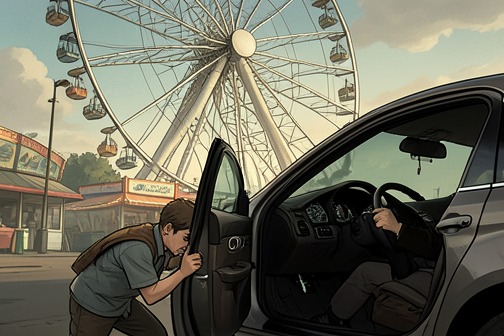
[Scott Carey](entity:character-recall-character-scott-carey-6772d18d7f70) meets [Clarice](entity:character-recall-character-clarice-4610eb332d49) at the [Carnival Grounds](entity:location-recall-location-0627f5cf05fa) after slipping out of the car where he has been waiting for [Louise Carey](entity:character-recall-character-louise-carey-d35b70c28bb0). The meeting is decisive because, amid a place that has become impossibly large around him, he finds a room arranged at his scale and a person who recognizes that she may be like him. His escape begins in frustration and exposure; it ends at the threshold of an unexpected human connection.
## Leaving the Car and Entering the Carnival
The carnival first reaches Scott as a spectacle he can watch but no longer inhabit. The Ferris wheel’s small seats rock above the ground, the Loop-the-Loop’s arms flash past one another, and the merry-go-round turns to the distant grind and thump of its machinery. Those rides recall the boy he used to be: gripping a Ferris wheel safety bar, steering toy cars, and enduring the delighted dizziness of the Loop-the-Loop. The remembered carnival was a place of abundance and exhilaration; this one is another world, observed from a radically altered scale.
Scott’s decision to leave the car collides with the practical limits of his size. He cannot raise the door handles. After jerking at them, kicking the door, and pushing a front seat forward so he can climb over it, he rolls down the window and lowers himself onto its narrow ledge. He reaches for the exterior handle and swings down, but his fingers slip from the chrome and he falls against the car. The fall briefly makes him fear he cannot get back in; he presses on because Louise will return soon and because he has already decided not to remain inside.
Outside, ordinary distances become hazards. Scott jumps from the curb and crosses a street only after a car roars past; although it is several feet away, its engine and tires sound overwhelming at his scale. He darts behind a tent, then moves along its dark canvas wall, listening to the carnival. When a man rounds the tent and walks past without seeing him, Scott understands how readily people overlook anything below their ordinary field of attention. He threads his way beneath the tent ropes, using the gaps they make against the ground as passageways.
## The Voice and the Trailer
A man’s approach sends Scott running for cover behind a trailer parked beyond the tent. From behind one of its thick tires, he watches the man search the area and then leave. Only after the immediate danger has passed does another sound redirect him: someone singing overhead. Scott recognizes the voice as coming from a lit window with a white curtain. The song leaves him restless; the screams from the Loop-the-Loop briefly break his absorption, but he returns to the trailer and waits until the singing ends.
The steps to the trailer door are the right height for him. Scott climbs them slowly, holding the railing, and approaches a room that appears to answer the scale of his changed life. Its chairs and couch are things he can sit on without being engulfed; its tables are within reach rather than towering structures he must pass beneath; its lamps can be switched on and off. Against the outsized machinery and furniture of the carnival, this interior offers not merely shelter but the possibility of ordinary use. The sign beneath the window identifies the trailer as Mrs. Tom Thumb’s, linking its miniature setting to the public world of the carnival while Scott experiences it as a rare space suited to him.
## Recognition Between Scott and Clarice
A woman enters the little room and sees Scott standing there. When she opens the door, he nearly slips from the step and catches himself against the railing. She asks who he is in a frightened whisper. He gives his name, Scott Carey, but she does not recognize it. Her next question is whether he is like her. Shivering, he answers that he is. The exchange establishes their connection through what each can perceive in the other, not through reputation or an explanation of how their circumstances came about.
Scott tells her that he heard her singing, and she invites him inside. He accepts without hesitation, experiencing the welcome as if he had known her for a long time and returned from a long journey. Once indoors, he admits that he is the shrinking man. Clarice is silent for a moment; Scott cannot tell whether her response carries disappointment, pity, or emptiness. The uncertainty matters: recognition does not instantly dissolve his exposure or settle what she thinks of him. Yet they continue to look at one another, and when Clarice gives her name, their small hands clasp and remain together.
## Significance of the Encounter
The meeting turns on a sharp contrast between being unseen and being recognized. Outside, the passing man fails to notice Scott because he does not look down; inside the trailer, Clarice sees him, asks whether they share something, and gives him her name. Scott’s scale has made familiar places and objects inaccessible, but here it also becomes the basis for an immediate, reciprocal recognition. The encounter does not explain Clarice’s circumstances or promise a settled future between them. It gives Scott something more limited and concrete: a person he can meet at eye level, in a room where chairs, tables, and lamps are usable rather than monumental.
Event 14
Scott spends the night with Clarice
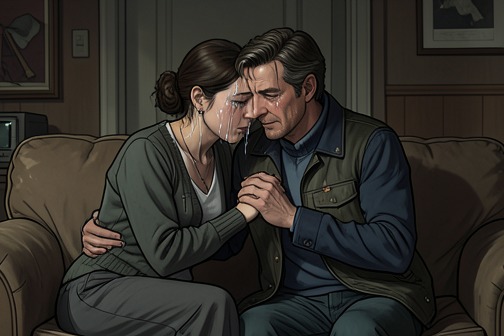
[Scott spends the night with Clarice](entity:event-recall-event-b34bcacd38b4) in an encounter that turns shared physical difference into intimacy and temporary refuge. The event matters not because it resolves Scott’s shrinking or repairs his marriage, but because it gives him a rare experience of being understood at his own scale. Its tenderness is inseparable from its cost: he must ask [Louise Carey](entity:character-recall-character-louise-carey-d35b70c28bb0) to accept his need for companionship, and the night offers relief without changing the future he fears.
## A Meeting at Their Shared Scale
The encounter gathers force through physical gestures before either character can explain what they feel. [Clarice](entity:character-recall-character-clarice-4610eb332d49) looks at Scott for a long moment, steps close, and rests her cheek against his; he puts his arms around her. Soon she is sobbing against him, her hands catching at his back, while they cling together in silence. Their tear-wet cheeks make their recognition bodily and immediate. For Scott, whose shrinking has separated him from the ordinary proportions of the people closest to him, the embrace answers a deprivation that words alone cannot meet.
They sit together on the couch, holding tightly to each other’s hands and smiling. Clarice says that she feels close to him despite never having seen him before. Scott explains the connection through their shared pity and isolation. His wish to be a man again emerges in the same moment as his wish to hold her: the longing is not only for restored physical stature, but for the closeness and ordinary touch that shrinking has made difficult. Clarice tells him that he has been alone, while she has known others like them and has had time to adjust because she has lived this way all her life.
## Clarice’s History and the Limits of the Refuge
Clarice’s account gives their connection a history beyond the immediate attraction. She tells Scott that she was once married and almost had a child. Her words reveal a life that includes relationships and possibilities Scott has lost, while her explanation that she has had time to adjust contrasts with his bewilderment at a condition he entered only after living at ordinary size. Their circumstances are alike, but their experiences are not interchangeable: Clarice has had a lifetime to inhabit her scale, whereas Scott is still grieving the family life and familiar world receding from him.
When Clarice asks how he came there, Scott tells her. She worries that his wife will be frightened if he stays away, and he urgently asks her not to make him go. Clarice draws him closer, then checks the time: she must give another show in ten minutes. The deadline places their private closeness inside Clarice’s working life, which continues even as Scott experiences the room as an escape from his other world. Her invitation to stay is offered with that obligation still pressing on the scene; it is not a promise that his larger predicament can be suspended indefinitely.
Clarice also worries about how her actions will be judged. She insists that she has lived decently and explains that the force of her feeling comes from the rarity of finding another person like them. In her view, their situation is unlike that of two people among a world of people who are all alike: they could travel a thousand miles without finding another. The claim makes their intimacy both personal and precarious. Their shared difference draws them together, but the scarcity that gives the bond its intensity also underlines how isolated they remain.
## Louise Carey’s Decision
The encounter becomes a direct conflict when Scott explains his need to Louise Carey. He argues that they are no longer the same, that their lives have separated, and that she may have companionship if she wants it while he cannot. He expects her to remarry when his shrinking is over in the sense of reaching its end; for him, the prospect ahead is continued diminishment, loneliness, and eventual dissolution. Clarice, he says, offers companionship, affection, and love now. His request is specific: one night of peace, made possible in part because Clarice’s trailer has furniture suited to his size.
Scott’s plea does not conceal that his attachment has become love, but he presents the night as a brief chance to escape the loneliness of his condition, not as a cure for it. Louise Carey weeps silently as she listens. After struggling to contain her sobs, she tells him that stopping him would be pointless and cruel, and that there is nothing she can do. Her response is an act of painful permission rather than an uncomplicated endorsement. She promises to return in the morning, marking the separation as temporary while acknowledging the limits of what she can offer him.
## Return and Significance
After Louise Carey drives away, Scott remains in the wind-swept street until the red taillights disappear. He then runs across the street, feeling ill and miserable, and thinks that he should not have done it and that things are not the same now. Yet seeing Clarice’s trailer, its lit window, and the small steps leading to it brings back the attraction of that refuge. Scott experiences the return as stepping into another world and leaving the sorrows of the old one behind. He whispers Clarice’s name and runs to her.
The movement from the embrace to the street and back gives the event its emotional shape: welcome is followed by hesitation, the pain of Louise Carey’s departure, and a renewed choice to seek Clarice’s company. The night does not erase Scott’s obligations or alter the course of his shrinking. Instead, it makes visible the human need those pressures have intensified. Clarice can meet him at his present scale and offer affection without asking him to become what he was; Scott, in turn, finds in her a form of companionship that the people in his former life cannot provide in the same way. The refuge is real but bounded, and the return to it is a moment of relief rather than a lasting escape.
Event 15
Scott decides to survive and climb the cellar cliff
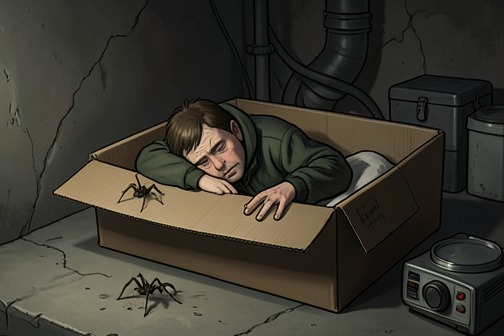
[Scott decides to survive and climb the cellar cliff](entity:event-recall-event-be6d84c0679a) at the moment when mere endurance begins to become deliberate action. After considering suicide while trapped beneath the box top, he wakes smaller, sick, and still alive; rather than accept either a miraculous explanation or the label of a will to live, he chooses to act as though survival remains possible. The decision turns the cellar’s ordinary debris into equipment and its furniture into a mountain route, converting despair into a hazardous, practical undertaking.
## From Exhaustion to Decision
Scott lies beneath the box top, listening to a spider crawl over the cardboard. He is thirsty enough to draw his hand back from a fragment of damp cracker, and so exhausted that even memories of the failed antitoxin treatment no longer have much force. He has imagined waiting until the spider leaves and then walking over the cliff to end his life. Instead, he falls into a heavy sleep.
When he wakes, the oil burner has clicked off and the cellar is silent. His headache and fever have eased, but his body still aches, and he cannot tell himself that sleep was an act of courage or a sign of some benevolent protection. He recognizes that he had neither a will to live nor, despite his earlier plan, a will to die. The box top’s increased weight confirms what he had meant to check against the ruler: overnight, he has shrunk to two-sevenths of an inch. He struggles out from beneath the cardboard, then walks unsteadily across the cement without measuring himself. The diminished body and the passage of another night make the crisis physical as well as philosophical.
At the box top, he considers going back to sleep and surrendering again. The spider’s territory rises above him, but he makes himself look for cracker crumbs instead. Finding one dirty crumb, scraping it clean, and chewing it becomes the small action from which a larger decision develops. He asks himself whether the cellar is his universe and whether he can determine its values and meanings. Whatever kept him from suicide, he concludes, has left his existence unbroken; he can still make decisions. He tells himself to act alive, and the choice shifts his attention from the finality of his circumstances to the next task.
## Turning Debris into Equipment
The change in purpose is accompanied by a concrete reward. Behind a cement block, Scott finds a large piece of cracker, cleans it, and eats it despite its bad taste. He treats it as nourishment, then heads toward the clothing carton, whose contents had already sustained earlier efforts: he had obtained thimbles and material for a robe there, as well as thread used to reach crackers. His earlier fury at the carton, which had once driven him to kick it open, has become useful in retrospect. The objects gathered during previous struggles now make a new attempt conceivable.
He first picks up a needle, but it is too heavy to carry up the cliff. He replaces it with a pin, prying one from a rubber cork after forcing the cork to topple. To keep the pin from dangling or cutting him as he climbs, he makes a sling from thread, weakening the fibers with the pin’s sharp point and tying loops around its head and near its point. The improvised carrying method is a practical response to the scale of the obstacle: even a small tool is cumbersome to a person now only two-sevenths of an inch tall.
A second pin becomes a proposed grappling hook. Reasoning from the equipment used by mountaineers, Scott rejects cleated shoes and alpenstocks as unworkable but recognizes that a bent pin attached to a long thread could catch in openings in the lawn chairs. He takes another pin and, to his scale, roughly twenty feet of thread from the carton, carries them out, and drags them across the floor. He also prepares food and water: cracker crumbs and a piece of [Sponge](entity:object-recall-object-sponge-8e3cb019d481) soaked with water from the hose, carried in his robe. The pin spear, the pin hook, and the water-bearing Sponge give the climb its basic tools, though he knows that only two days remain to him regardless of what he attempts.
## The Climb and Its Cost
Bending the hook by levering its point under the cement block takes tremendous effort. So do tearing off the Sponge, collecting water and crackers, and hauling everything to the foot of the lawn-chair cliff. Yet the work itself marks a decisive contrast with the night before: suicide has become a distant impossibility, and Scott is pleased simply to be alive and trying. His excitement falters when he looks up at the chairs, which rise toward the wall like Everest. The scale of the route remains daunting even after he has built equipment for it.
The route requires more than a direct ascent. Later, Scott calculates that the chair arm lies about fifty feet above his position and sees that there is nowhere for his hook to catch on the face nearest him. He must descend partway and climb around the back, where he can thread the hook through openings between the slats. The lower shelf slopes beside the seat and is comparatively manageable; the vertical rise to the seat is the hard section. As he works, the thread and hook bridge gaps that his body cannot cross unaided. The cellar’s construction dictates the route, turning slats, gaps, and chair supports into successive stages of a mountaineering problem.
At the chair’s top slat, after an hour of climbing, the pin hook is almost unbent. Scott lies down, exhausted, and looks back across the immense face he has just climbed. He remembers that his back once could have covered that whole area and that he once could have carried the chair. The comparison gives the ascent its bodily measure: the furniture has not changed, but his shrinking has transformed it into a landscape. Exhaustion briefly quiets thoughts of the spider and the past; after what seems to have been a short, dreamless sleep, he takes up his equipment and crosses the chair arm with the thread trailing behind him.
The next stages remain precarious. He hooks onto a croquet wicket and climbs its smooth, curved metal length while carrying the weight of the thread, hook, and spear. Several times he loses his balance and spins beneath the wicket, hanging there until he can recover his grip. By the time he reaches the upper chair’s shelf, his muscles are cramping, his forehead is scraped against rough wood, and his feet extend over a drop that looks seven hundred feet deep. From above, the cellar changes scale again: the red hose resembles a motionless serpent, the cushion a flowered plain, and the box top where he slept a small gray square. The ascent has made the familiar cellar appear both vast and newly legible.
## Bread Reached, Danger Unresolved
From the chair, Scott reaches the clifftop and takes shelter behind the glass base of a large, bell-shaped fuse. In the shaft of light near the dusty window, he sees pipes and wires overhead, scraps scattered across the floor, and paint cans and jars looming in the distance. He looks carefully for the spider but cannot see it. Its absence does not reassure him: he believes it has sensed him before and may remember him. He plants the spear in the sand and begins eating a piece of bread, whose taste restores an appetite the crackers had not satisfied. After eating and drinking the remaining water, he throws away the Sponge that has carried it.
The bread is too large to carry intact. Scott hacks off a piece about twice his own size, catches it with the hook, and drags it back toward the cliff, cutting a road through the sand. At the edge, he props the chunk upright and pushes it over. It falls, sheds crumbs like snow, and breaks into three pieces on the cellar floor. He has completed the difficult climb and secured food, but the expected relief does not arrive: tension remains in his body, and a cold knot of distress stays in his stomach. The event therefore ends not with safety or escape but with a limited achievement. Scott’s decision has carried him from passive contemplation of death into strenuous action; it has not made the spider, the shrinking, or the precariousness of his situation disappear.
Event 16
Scott hunts down the giant spider
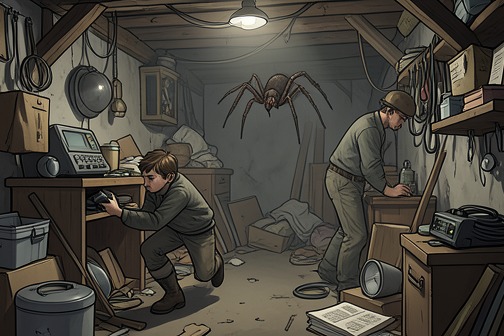
[Scott hunts down the giant spider](entity:event-recall-event-d76bf9c852bb) in a contest shaped as much by his shrinking scale as by his decision to stop fleeing. He understands the [Black widow spider](entity:creature-recall-creature-91703d2c1252) as more than an immediate predator: it has come to represent something he hates and believes he cannot coexist with. Since he expects to die eventually, he chooses to risk himself trying to destroy it. The hunt becomes a concentrated test of that choice, moving from careful preparation to a failed trap, improvisation, and finally the spider’s death. Scott survives the encounter, but it does not remove the danger of his wider predicament.
## Decision and Preparation
Scott does not regard the decision as simple. He wonders whether he is acting because he cannot truly believe that he will disappear soon, just as a young, ordinarily healthy person may find death difficult to imagine. He sets that uncertainty aside: what matters, he decides, is what he does now. Rather than let fear decide for him, he commits to pursuing the spider even if the attempt costs his life. His resolve is therefore not confidence that he will win; it is a refusal to let the uncertainty of his future prevent action in the present.
His first plan borrows from the logic of hunting a larger beast. Scott will dig a pit, leave the [Pin spear](entity:object-recall-object-6180bdd7d2e9) point-up in its base, lure the spider over it, and cover the opening after it falls. He uses the Pin spear to scrape out the sand, working for forty-five minutes before the pit is finished. The work itself creates a further hazard: without the [Thread](entity:object-recall-object-a5203909b9c8) hanging down, he would be trapped in the steep-sided hole. He secures the spear point in the bottom with packed, wet sand, climbs back out by the Thread, and pulls the line after him.
The trap is designed to solve the problem of scale. Scott fears that confronting the spider directly with the Pin spear would leave him exposed to its force; from his reduced size, even its movement could knock him over. He recalls an earlier encounter in which its leg passed over him and rejects repeating that method. Yet the pit has weaknesses he cannot dismiss: the spider may climb the walls, avoid the point, or spring away before reaching it. He finds a flat piece of cardboard wide enough to cover the opening and settles on a sequence that depends on timing: the spider must fall, and Scott must close it in before it can escape. Knowing that hesitation may undo his resolve, he sets out to find it.
## Baiting the Spider
Scott prepares stones as another means of provoking the spider. The oil burner roars in the distance, making the sand tremble; when it stops, he throws a stone toward the creature on its web. The first misses and tears a hole in the web. The spider moves, then becomes still again, while Scott’s own caution urges him to retreat. Instead, he continues. He throws another stone, then more, until the spider responds and comes down from the web.
The moment turns Scott from hunter into quarry. He runs across the sand toward the pit, repeatedly checking the spider’s position and struggling to keep his direction. His fear becomes acute enough that he briefly thinks he is falling, though he is still running. He cannot see the pit at first, and the spider is gaining on him. When the pit finally comes into view, he stops at its edge rather than immediately leaping away. The plan requires him to wait until the spider is almost upon him, making the trap’s success depend on holding his ground at precisely the point when flight seems most urgent.
## The Trap Fails
Scott springs aside at the last moment, and the pursuing spider falls into the pit. He slides the cardboard over the opening and throws himself across it, attempting to hold it shut while the creature struggles underneath. For an instant he believes that the plan has worked. Then the cardboard tilts, and he has to leap clear as the spider forces its way out. The creature emerges with the Pin spear still impaling it, dragging the weapon behind; the intended trap has failed to contain it, and Scott is again exposed at close range.
The failure does not end the encounter. Scott turns to the Thread and a [Pin hook](entity:object-recall-object-4e9da0267eb8), swinging the hook around himself before the spider runs into it. He secures the line around a heavy piece of wood, making the wood an anchor that restrains the spider’s movement. The arrangement gives him room to act, but it does not make him safe: the creature can still reach toward him, and at one point a leg catches his shoulder before he breaks free. The Pin hook, Thread, and anchor thus replace the pit as a means of controlling distance, converting items he can handle into an improvised restraint.
## Killing the Spider
With the spider tethered, Scott takes up the Pin spear again. He uses it repeatedly when the creature surges toward him, keeping the point between them. As it weakens, he has the option of leaving it to die on its own. Instead, he chooses to approach and end the struggle. The decision marks a change in his attitude within the fight: the spider remains the threat he set out to destroy, but Scott also feels pity for it and does not want its suffering to continue. He enters the limited space created by the tether and meets its final lunge with the spear.
The spider falls still on the sand, and Scott collapses unconscious after the confrontation. When he comes around, he confirms that the encounter was not a dream. The spider is dead, but the result is not a complete escape or a safe ending. It is almost night, and Scott still needs the Pin hook; more immediately, he has to get down the cliff before darkness makes the descent impossible. The killing therefore resolves the immediate predator-prey conflict while leaving the practical danger of the landscape and the approaching night in place.
## Significance of the Encounter
The hunt is organized around a reversal of scale. Scott cannot meet the spider on equal physical terms, so he builds a pit, uses a cardboard cover, and turns the Thread, Pin hook, wood, and Pin spear into a sequence of devices for managing distance. Each plan is vulnerable to failure, and the fight advances through improvisation rather than mastery. The pit does not hold; the tether does not remove danger; survival depends on Scott adapting while the spider remains capable of reaching him.
His motive also exceeds simple self-preservation. Scott recognizes the Black widow spider as a symbol of something he despises and cannot accept living alongside, yet he does not claim certainty about what the hunt will accomplish or whether he will live. By acting despite that uncertainty, he makes the present struggle more important than speculation about tomorrow. The final choice to end the spider’s suffering complicates the initial resolve to destroy it: Scott’s resistance is fierce, but it does not erase his capacity for pity. The event closes with a hard-won victory that brings neither restoration nor repose, only a dead predator, a recovered consciousness, and the next urgent task of descending before night.
Event 17
Scott tries to catch up with his moving family
The family’s move turns a brief chance of escape into a failed pursuit: Scott sees [Marty](entity:character-recall-character-marty-5c0e5c16ff29) and [Beth Carey](entity:character-recall-character-beth-carey-9e416f59f392) clearing the cellar, realizes they are leaving, and tries to catch a ride on Marty’s trousers. The episode makes departure both a practical opportunity and a measure of Scott’s isolation. At his scale, an ordinary packing job is a sequence of enormous, dangerous movements; even when he reaches the stairs, he cannot make the family recognize that he is still there.
## The move becomes visible
The scene begins with Scott watching a giant clear the cellar. The man reaches across the red metal table, throws down large cartons, and pulls out a blue suitcase that Scott recognizes as [Louise Carey](entity:character-recall-character-louise-carey-d35b70c28bb0)’s. A glen-plaid suit identifies the figure as Marty, not the giant Scott had seen on Wednesday. What first appears to Scott as an alarming disturbance becomes legible as packing: cartons, canvas chairs, and a net pole are moved, and Marty takes another suitcase. Scott understands the implication only when the objects assemble into a pattern. The family is moving.
That recognition changes the meaning of the cellar’s activity. The cartons and furniture are not simply hazards crossing Scott’s landscape; they are the visible signs that the people who share his home are about to leave it. Beth Carey bends to take a suitcase, while Scott runs toward Marty and calls out to him. His urgent appeals do not interrupt the work. The contrast is stark: to the family, the cellar is a space being emptied; to Scott, it is the last place from which he might reach them.
## A plan built around Marty’s return
Scott initially judges the climb to the cellar’s upper level impossible at his current size. Hope returns when he remembers that Marty has said he will come back down. Rather than attempt to climb a shoe without a secure hold, Scott forms a more deliberate plan: seize Marty’s trouser leg, perhaps get inside the cuff, and hold on until Marty carries him into the house. Once there, Scott imagines reaching a table or chair and waving cloth so Louise Carey will know he is alive. The plan is not simply escape from the cellar; it is an attempt to make himself visible to his family again.
He recognizes that the opportunity may be brief. Marty would pass the step too quickly for Scott to act if he waited for him to return, so Scott decides he cannot wait. He races toward the red metal table as Marty lifts a carton and heads for the stairs. The difference between planning and execution is compressed into that narrowing interval: Scott has identified a route, but must take it while the person carrying it is already moving.
## The attempted attachment fails
As Marty’s black shoe comes down in front of him, Scott flings his hook toward the swaying trouser leg. The attachment catches, but not in a way Scott can control. Marty’s movement pulls Scott through the cellar, swinging him violently and carrying him toward the steps. He reaches the first step, but the impact tears him free. Scott then moves across the cement toward the second step, loses his footing, and is left on the floor as Louise Carey’s shoe comes down close by before moving away.
The result reverses the promise of Scott’s plan. Marty’s movement does carry him toward the stairs, but the ride is uncontrolled, and reaching the steps does not become a safe ascent. Scott’s attempt ends before he can enter the house or signal to Louise. The danger comes not from deliberate opposition but from the mismatch between his small body and the scale and speed of ordinary actions around him. A trouser leg can serve as a ladder only if Scott can hold on; a step can be a route upward and, at the same time, an obstacle he cannot negotiate.
## What remains after the family leaves
Later, while Marty is driving the family to the railroad station, Beth notices the hook and thread attached to his trouser leg and removes them. Marty assumes he picked them up in the cellar. Beth puts them in her overcoat pocket, and then forgets them too. The objects that carried Scott’s attempt into the family’s immediate space therefore fail to carry its meaning. The family takes the hook and thread away, but neither recognizes them as evidence that Scott tried to follow.
This aftermath sharpens the episode’s separation. Scott’s effort is physically close to success: his improvised line reaches Marty, and his presence comes within a short distance of Louise. Yet proximity does not produce recognition. For Scott, the moving family offers a possible passage from the cellar back into shared life; for Marty and Beth, the attached thread is only something picked up among the household’s possessions. The move continues, while Scott remains behind, and the difference between being near his family and being known by them becomes the event’s decisive consequence.
Event 18
Scott Is Placed in the Dollhouse by Beth
[Scott Carey](entity:character-recall-character-scott-carey-6772d18d7f70)’s placement in the [Dollhouse](entity:object-recall-object-d2b8e69fe691) by [Beth Carey](entity:character-recall-character-beth-carey-9e416f59f392) turns a domestic gesture into a near-fatal encounter: for Beth, lifting her father is an easy way to help him, but for Scott, her hand is powerful enough to bind and nearly crush him. The episode gathers the consequences of his shrinking into one intimate scene, where love and danger coexist because the family can no longer safely share the same physical world.
## The Dollhouse as a Domestic Arrangement
The Dollhouse enters Scott Carey’s life when he is ten inches tall, at a point when shrinking has also begun to silence his work. [“Life in a Dollhouse”](entity:expression-recall-expression-life-in-a-dollhous-97d3a091d576) was the title of the last chapter of his book; after finishing it, he found he could write no more. A pencil, even the smallest one, was as large as a baseball bat. He considered using a tape recorder, but before he could do so, he had become unable to communicate. The dollhouse therefore arrives not simply as a toy, but as a proposed home at the edge of his diminishing ability to participate in ordinary life.
[Louise Carey](entity:character-recall-character-louise-carey-d35b70c28bb0) brings home a deluxe model, made affordable by sales and resales of Scott’s book. At first he is resting on a cushion beneath the couch, where Beth will not accidentally step on him. He crawls out to meet Louise as she kneels and brings her ear near his mouth. Although he initially means to tell her that he does not like the gift, he looks at her and says, “It’s very nice.” His response registers the care behind the offering even as the arrangement exposes how little his preference can alter the conditions imposed by his scale.
The house has a porch with a small wrought-iron railing, fluffy white curtains, hardwood floors, a window seat, candle brackets, and a fireplace made of false bricks. Scott recognizes an unsettling resemblance between standing on its porch and standing on the steps of [Clarice](entity:character-recall-character-clarice-4610eb332d49)’s trailer. Inside, however, the model’s charm is interrupted by its open side: one wall is missing, and Louise watches him through that opening. She later pushes the house against the wall behind the couch, giving him both privacy and the protection of four walls. The Dollhouse is refuge, but its visible opening and miniature construction also keep his dependence on the larger household in view.
## A Home That Cannot Fully Function
By noon, the furniture has been installed, and Scott has asked Louise to provide practical adjustments. Beth is under strict orders not to approach him, while the [House cat](entity:creature-recall-creature-bd0cbfb4fc38) remains a danger if it gets inside. Louise adds an extension cord and a small Christmas-tree bulb for light, having initially forgotten that he would need illumination. Plumbing is impossible. These details make the home a negotiated adaptation rather than a complete solution: safety and light can be arranged, but essential conveniences cannot.
The furniture makes that limit tangible. The chairs, including those in the living room, have straight backs and no cushions; the bed has neither springs nor a mattress, so Louise sews cotton padding into a piece of sheet. More broadly, the furnishings imitate use without reliably enabling it. The piano’s keys are painted on and its interior is hollow; the refrigerator is a single solid piece; the stove knobs turn without producing heat; the sink’s faucets yield no water; and clothes placed in the washer would remain dirty and dry. Burning scraps in the fireplace would only fill the house with smoke because it has no chimney. Scott can occupy the miniature rooms, but their familiar objects mostly reproduce the appearance of domestic life rather than its functions.
## Beth’s Ride and Scott’s Physical Danger
The later incident follows an earlier journey connected with the family’s move. While [Marty](entity:character-recall-character-marty-5c0e5c16ff29) is driving Louise and Beth to the railroad station, Beth notices a hook and thread caught on Scott’s trouser leg and plucks them free. Marty guesses that he picked them up in the cellar, then forgets the matter; Beth pockets the hook and thread and forgets them too. The forgotten objects offer a small measure of how easily Scott’s possessions and dangers can disappear from the attention of people who live at an ordinary scale.
In the ensuing encounter, Beth picks Scott up and carries him toward the Dollhouse. The movement is no harmless lift from his perspective: her hand clamps around his body from shoulder to hip, pins his arms, and squeezes out his breath as the room blurs and he begins to black out. She sets him on the porch, where he catches hold of the wrought-iron railing and finds Beth looking down at him with frightened eyes. She explains, “I gave you a ride.” Her words describe an act of help, but his body has experienced it as confinement and near suffocation.
Scott gets through the front door, shuts it, and snaps the tiny hook into its eye. He collapses inside, breathing with a dry rasp. Outside, Beth insists, “I didn’t hurt you.” Scott does not answer; he feels as though he has nearly been crushed in a vice. When Beth repeats that she did not hurt him and begins to cry, the difference between intention and consequence becomes explicit. She is not responsible for failing to understand fully what her hand can do, but Scott recognizes that he can no longer postpone asking Louise to keep her away from him.
## Aftermath and Significance
After Beth goes outside, Scott retreats to the small cushions Louise has made for him and lies staring at the shadowy ceiling. The floor’s trembling and the crash of the front door mark Beth’s departure through sensations that his reduced body registers with painful force. He thinks of his lost child, and the narration turns to Beth’s birth: Louise’s long labour, Scott waiting through the night, and his attempts to rest in the car or pass the time in the hospital alcove. The recollection places the frightened child at the Dollhouse beside the daughter he had once waited to meet, intensifying the emotional cost of needing protection from her.
The episode’s reversal is not that Beth becomes cruel, but that ordinary care has become hazardous without either person intending harm. The Dollhouse protects Scott from accidental steps and offers privacy, yet Beth can cross its scale boundary with a single movement. Its porch, railing, and closing door are at once the fixtures of a miniature home and the barriers Scott must use to recover control of his body. The scene makes shrinking a practical family crisis: affection remains, but safe contact must be renegotiated because the same gesture now carries radically different consequences for father and daughter.
Event 19
Scott Is Attacked by a Sparrow in the Blizzard
[Scott Is Attacked by a Sparrow in the Blizzard](entity:event-recall-event-43142e955f76) is a reversal in [Scott Carey](entity:character-recall-character-scott-carey-6772d18d7f70)’s attempt to escape the cellar: after reaching the snowy yard, he is attacked by a [Sparrow](entity:creature-recall-creature-76a24a9e5b7f) and driven through a broken cellar window into the confinement he had been trying to leave. The danger comes not from a single obstacle but from a chain of ordinary forces transformed by his scale and exposure—a draft, a closed door, deep snow, cold, and a bird whose beak can wound him. His escape becomes a desperate choice between the imprisoning cellar and the open storm, and the attack resolves that choice by force.
## From the Christmas Tree to the Snow
The scene begins in the warmth and miniature spectacle of the Christmas tree. Standing in a hay-strewn stable among the Nativity figures, Scott Carey imagines the faces of Mary, Joseph, and the Wise Men as nearly alive; he hears the animals in their stalls and the infant’s faint gurgling. The impression of shelter ends when a cold wind crosses him. The kitchen door has blown partly open, and powdery snow is moving over the floor. [Louise Carey](entity:character-recall-character-louise-carey-d35b70c28bb0) is showering, while [Beth Carey](entity:character-recall-character-beth-carey-9e416f59f392) is outside. Scott first tries to get Beth’s attention, then hurries toward the door himself.
A [House cat](entity:creature-recall-creature-bd0cbfb4fc38), wet and disheveled after drinking milk, turns the open kitchen into a new danger. It advances with its claws extended as Scott backs away from it, the icy draft at his back. Beth comes through the front door, and the sudden rush of air slams the back door shut, carrying Scott with it and dropping him into a bank of snow. The movement is abrupt and accidental, but it changes the scene’s stakes at once: he is no longer only trying to evade the cat. He is outside, separated from the house by a closed door, in a storm he cannot endure for long.
Scott pounds and kicks at the door, calling for Beth, but the wind drowns out his voice. Snow falls from the railing nearby and scatters across him. When he turns toward the yard, its familiar features have become a hostile landscape: drifts rise like dunes, trees stand as enormous white columns, and the fence appears as a barrier stripped by the wind. The scale of the storm makes the yard seem less like a route home than an exposed wilderness.
## A Choice Between the House and the Storm
Scott recognizes that remaining on the porch may mean freezing to death, yet the house still appears to offer the only immediate safety. He cannot simply enter elsewhere: the cellar windows are locked from inside, the doors are too heavy for him to lift, and the space beneath the porch would offer no warmth. He considers climbing the front-porch railing to reach the bell, which might bring someone to the door, but the snow is deep and the route uncertain. Waiting also carries a risk: Louise Carey might find him, but she might not do so in time.
The decision therefore has no secure option. Scott leaves the back porch and jumps down its steps, using the piled snow to cushion the drops. He slips, plunges his arms into the snow, and strikes his face against its numbing surface. At the next drop he pitches into a deeper cone of snow, struggles upright, and keeps moving. He cannot run; he can manage only a staggering walk as his legs sink and pull free again. The snow clings to him, the wind cuts through his clothes, and his hands and feet are already going numb.
At the corner of the house he sees the covered Ford in the distance, its tarpaulin dotted with peaks of snow. It offers no immediate solution, and getting there would mean crossing more of the exposed yard. Scott presses onward, repeating to himself that he will make it. The effort is not a confident march toward freedom but a series of small advances bought against cold, exhaustion, and the ground itself.
## The Sparrow’s Repeated Assault
The Sparrow strikes suddenly, its weight knocking Scott down into the snow. He manages to see it diving back toward him, then throws up an arm as it sweeps past on rigid wings. It circles and returns close enough for him to smell its wet feathers; its beak lunges at him as he tries to regain his feet. The encounter overturns the expectation that the open yard, however cold, is safer than the house. The storm is no longer the only immediate threat, and the bird can pursue him faster than he can cross the snow.
Scott fights with what the landscape provides. He scoops up snow and flings it at the Sparrow’s head; the bird rises, chatters, and circles him in tight, blurring sweeps. When it dives again, Scott throws himself forward, but the bird knocks him over. He runs a few feet, is struck down again, and lashes out with his hands as its wet wings pound at his head. Each brief reprieve buys him only a few more inches. The snow can blind or distract the attacker, but it cannot keep the bird away for long.
The passage makes the struggle repetitive by design: Scott pushes through the snow, hears the drumming approach, drops or turns, and throws another cloud of snow into the Sparrow’s eyes. Those repeated actions are a survival tactic, but also a measure of how little control he has. He cannot overpower the bird or outrun it. He can only interrupt its attacks long enough to move a short distance, while the cold continues working on his body between each assault.
## Driven Back Through the Broken Window
Eventually Scott reaches the cellar window, whose missing pane leaves an open square in the house wall. He stands with his back to it, still throwing snow at the Sparrow, and hopes the bird will give up before he has to leap into the cellar. That opening offers a route out of the storm, but it leads back into the place from which he had been trying to escape. His hesitation makes the window a bitter refuge: survival may require returning to confinement.
The Sparrow does not relent. Its beak hammers at Scott’s skull, cuts his skin, and knocks him against the house. Dazed, he misses when he throws snow; the bird continues striking his face. At last he turns and leaps for the open window. He crawls through, but the pursuing bird knocks him onward. Scott falls onto the sand beneath the window, crying out as he lands. His leg is twisted, and he cannot stand on it. The escape attempt ends not with a chosen return but with the attack physically forcing him through the opening.
## Aftermath and Reversal
Scott lies on the cellar sand in a tangle of limbs. Ten minutes later, footsteps sound overhead; the back door opens and closes. Louise Carey and Beth Carey walk around the house and across the yard, trampling the snow and calling his name. Their search continues after darkness falls. The contrast is stark: from above, they move through the same yard looking for him, while Scott remains below the window, injured and unable to answer effectively.
The episode turns a domestic winter scene into a contest over access and survival. The Christmas stable, the kitchen door, the yard, and the cellar window are all parts of a familiar home, but none functions as secure shelter for Scott without difficulty. The storm magnifies the consequences of his smallness, while the Sparrow makes a commonplace animal into a predator capable of driving him back into captivity. He survives the immediate assault, but the result is not freedom: the broken window becomes the threshold through which the blizzard and the bird return him to the cellar.
Event 20
Scott Escapes the Cellar
[Scott Escapes the Cellar](entity:event-recall-event-3158f506bcd9) is the final break in [Scott Carey](entity:character-recall-character-scott-carey-6772d18d7f70)’s confinement: after his family has left and his prospects seem exhausted, he finds a route from the cellar floor to an open window and steps outside. The escape is both a practical feat assembled from objects at hand and a reversal in his outlook. He acts again when he had concluded that further effort was pointless, and reaches the world beyond the house while knowing that freedom cannot stop his shrinking or extend his remaining time.
## Confinement and the Failed Routes
The escape begins after Scott is left alone in the cellar. [Louise Carey](entity:character-recall-character-louise-carey-d35b70c28bb0) and [Beth Carey](entity:character-recall-character-beth-carey-9e416f59f392) have searched around the house and yard, calling for him until darkness, but they do not find him. He hears the water pump stop and understands that the house is empty. His repeated recognition of being alone marks the immediate change in his situation: the search has ended, and there is no one nearby to help him or even know where he is.
The cellar has already defeated several attempts to reach its windows. At seven inches tall, Scott could not climb the boxes and suitcases below the window over the fuel tank. The broken-pane window was higher still, with a vertical wall beneath it, while the window over the log pile offered even less access. He once reached the fuel-tank window but had no stone with which to break its pane, and had to climb back down. The route he finally takes is therefore not a simple return to an exit he had overlooked; it becomes possible through a changed combination of access and equipment.
At first, the sight of the window deepens his sense of defeat. He turns away because seeing the sky and trees makes the thought of never going outside again unbearable. He considers his previous efforts—climbing threads, killing spiders, and searching for food—as actions that may all have come to nothing. Then his attention settles on the long net pole leaning against the cellar wall. The object prompts a sudden shift from resignation back to action.
## A Route Assembled from the Cellar
Scott jumps down from the [Sponge](entity:object-recall-object-sponge-8e3cb019d481) and runs toward the pole, briefly stopping when he remembers food and water. He decides he will not need to gather supplies for a long journey, drinks from the [Cellar hose](entity:object-recall-object-ddc4e2385b4a), and continues. He climbs the metal rim of the net, passing its thick cords, until he can pull himself onto the pole. Its width and shallow angle make it less like a ladder than a sloping road: he can move nearly upright rather than hauling himself upward hand over hand.
As he climbs, Scott wonders whether the circumstances that have kept him alive have followed a purposeful pattern. The pole was left in just the position he needs by his brother, and the spider’s death the previous day has removed another obstacle. He cannot establish that these events mean anything beyond coincidence, and his own awareness that desire may be shaping his interpretation remains part of the moment. Still, the possibility of a route out gives his movement a new charge. He continues up the pole, past the first lawn chair and then the second, until he reaches the top of the cellar’s great rise and collapses, exhausted.
He does not stop there. With darkness approaching, Scott gets up and runs across the cellar floor. He passes the dead spider without pausing, treating that earlier struggle as one step already completed rather than the purpose of the journey. He tears off a piece of bread and tucks it under the Sponge, then heads for the spider’s web. The web is sticky and sways under his weight; he has to pull his hands and feet free from one strand before reaching the next. He climbs past a dead beetle without looking at it, then reaches the top and gets onto the wooden shelf that runs around the wall.
## From the Shelf to the Open Window
Once on the shelf, Scott can run. The narration renders his progress in large distance measures—three blocks, a turn, then a mile—although he is moving along a beam in the cellar. The contrast makes the route legible on his radically altered scale: a household structure becomes an extended passage, and the cellar remains a landscape that has to be crossed rather than a room that can be traversed at a glance. He runs until he can hardly breathe, then enters blinding light.
Scott stops and feels the wind on his face. The recognition that he is outside occupies his attention completely. He then pulls himself up the few inches to the open square of the window, climbs over its wooden rim, and jumps down. His legs tremble as he crosses the cement walk; at the edge of the world, he stops and looks. The measured, quiet movement over the sill contrasts with the urgent run that brought him there. The crossing is a real escape from the cellar, but it does not restore his former scale or make the surrounding world familiar again.
## Freedom and the Remaining Night
Outside, Scott finds shelter beneath the porch, where the house blocks the night wind. He lies among dry leaves with other leaves pulled over him, finds a dish of water, and has bread. From this protected place he looks at the stars. They appear unchanged to him, and their continuity brings contentment: although he is now extraordinarily small, the earth itself seems small beside the sky.
The escape therefore ends in a state more complicated than simple rescue. Scott knows that his shrinking has not stopped and believes that he has only that day left. Yet on the night he expects to be his last, he feels glad to be alive rather than afraid. The cellar’s enclosed darkness gives way to open sky, but the journey outward does not erase the approaching end. Its decisive consequence is instead a change in how Scott inhabits the time remaining to him: having acted, crossed the threshold, and found a place to rest, he can meet the night with a calm the prospect of extinction had not previously allowed.
Event 21
Scott Accepts His Finite Life and Finds Inner Peace
[Scott Carey](entity:character-recall-character-scott-carey-6772d18d7f70)’s acceptance of his finite life comes not with rescue or a promise of more time, but in a brief night of warmth beneath the stars. Though he believes his days will end within hours, he is glad to be alive. The scene turns his long struggle to survive into a different kind of victory: once hope has disappeared, he can face the end without terror, regret, or an audience whose approval he needs.
## A Place of Shelter at the Edge of the World
After climbing through an open window and stepping onto the cement walk, Scott Carey stops at what the narration calls the edge of the world. He lies on a soft mattress of dry, crinkly leaves, with other leaves pulled over him. The vast house blocks the night wind; he is warm and fed, and he has found and drunk from a dish of water beneath the porch. These modest comforts matter because they are immediate and sufficient. They do not change his circumstances or extend his life, but they let him rest in the world rather than fight it for a moment.
The setting preserves the contrast that has governed his experience: the house is vast beside him, while the world beyond it opens into an immense night sky. Yet this is not another scene of helplessness before overwhelming scale. Scott lies quietly on his back, looking upward. The physical smallness that has made ordinary surroundings dangerous does not prevent him from recognizing beauty or taking comfort in the familiar sight above him.
## The Familiar Stars and a Changed Scale
There is no moonlight. Darkness is broken only by the sharp points of the stars, which the narration compares to blue-white diamonds against black satin. Their beauty is striking, but the decisive comfort is that they remain the same: Scott sees them as any man sees them. That shared perspective briefly restores a measure of common human experience. His body may be small, but his view of the stars is not presented as lesser or diminished.
The thought also reverses the scale that has defined his ordeal. Scott recognizes that the earth itself is small compared with the stars and the larger universe. Earlier, his shrinking made the familiar world expand into a threatening landscape; here, the night sky makes that world seem small in turn. The reversal does not erase his vulnerability. Instead, it changes what scale means: being physically tiny does not make him the measure of all existence, and the vastness beyond him does not cancel the value of being alive within it.
## From Hope to Contentment
Scott understands that this night is the very one on which his life will end, and that only hours remain. The knowledge does not renew his earlier terror. He is glad to be alive even while expecting that life to end soon. The calm is significant precisely because it does not rest on a new possibility of escape or recovery. He has reached a point at which the end is near and he does not mind.
He distinguishes this state from the way he had endured the past. Before, he kept living because he kept hoping; hope, he reflects, is what keeps most people going. Now hope has vanished, but his ability to smile remains. He believes he has tried and has nothing to be sorry for. The change is not a denial that he is dying, but a change in what he requires in order to meet that fact: survival is no longer the condition for feeling that his effort mattered.
Scott calls this courage because it is not performed for recognition. No one is there to sympathize with him or praise him, and he has no expectation of commendation. His courage is inward and unobserved: it consists in facing the end without bargaining for approval or pretending that hope remains. The narration frames his contentment as a victory over himself, not a victory over the circumstances that have brought him to this moment.
## A Last Declaration
Scott says, “I’ve fought a good fight,” and initially feels embarrassed by the words. He then shakes off that embarrassment, recognizing that pride in what remains to him need not be suppressed. The declaration gives speech to a judgment he has reached privately: he has struggled, and the effort itself is enough to claim. He bellows the same sentence at the universe, then adds under his breath, “God damn it to hell.” The change in volume—from proclamation to muttered profanity—lets pride and bitterness coexist without undoing his acceptance.
His laughter is only a faint sprinkling of sound against the dark earth. It feels good to laugh, as does sleeping beneath the stars. The ending does not show his death; it leaves him resting in the final hours he believes are left to him. The quietness is the point. After repeated fear at the prospect of nonexistence, Scott can lie warm and fed, look at stars unchanged by his shrinking, and feel no need for anyone to witness his composure. His finite life remains finite, but for this moment he can inhabit it without hope and without terror.
Event 22
Scott Carey’s transition into the microscopic world
[Scott Carey’s transition into the microscopic world](entity:event-recall-event-scott-carey-s-transitio-86b4faccc87c) turns his apparent disappearance into a threshold rather than an ending. On waking beside the leaves where he had slept, he finds the familiar world transformed by scale: the [Sponge](entity:object-recall-object-sponge-8e3cb019d481) he wore becomes a jagged blue dome, and the leaf beneath him stretches into a plain. His discovery gives physical form to a new understanding of nature: there is no absolute zero at which existence must cease. He runs toward the light and enters a world where the practical work of survival begins again, accompanied by hope that he may not be alone.
## Awakening to a Changed Scale
The event begins with an ordinary morning gesture: [Scott Carey](entity:character-recall-character-scott-carey-6772d18d7f70)’s eyes open, and for a moment his mind remains clouded by sleep. Recognition arrives abruptly. He jolts upright and looks around, trying to understand where he is. The question is not simply geographical. The surroundings have become so unfamiliar that the measures by which he has understood his place in the world no longer seem adequate.
Above him, what appears to be a ragged blue sky is pierced by shafts of light. The space around him seems like an immense cavern, with an opening and brightness off to his right. He stands and discovers that he is naked, then searches for the Sponge. The apparent sky is the Sponge he had worn: an object once carried on his body now stretches hundreds of yards overhead. Its ordinary identity remains recognizable, but its scale has changed so completely that it reads as landscape.
Scott checks his own body, touching himself and finding that he is still himself. Yet that reassurance does not answer the central question: how far has he shrunk during the night? The uncertainty makes the scene a double discovery. His personal identity persists, while his proportions and surroundings have become almost impossible to reconcile with his former sense of reality.
## The Leaf as Landscape
Remembering that he had lain on a bed of leaves the night before, Scott looks down. He is sitting on a vast, speckled plain of brown and yellow, cut by great paths that angle away from a gigantic avenue and continue beyond his sight. The apparent terrain is the leaf beneath him. Like the Sponge overhead, it has not ceased to be an ordinary object; it has become immense in relation to him.
The recognition does not immediately make the scene comprehensible. Scott shakes his head, confronted by the seeming contradiction of being less than nothing. That bewilderment gives way to an idea: if he had looked upward the previous night at a universe without, perhaps there is also a universe within—and perhaps there are universes within universes. He has always known that microscopic and submicroscopic worlds exist, but had not connected their existence to his own progressive shrinking. The event converts abstract knowledge into a possibility he must inhabit.
## No Zero in Nature
Scott’s change in understanding depends on separating human measurement from nature itself. Inches belong to human reckoning; for a person, reaching zero inches appears to mean reaching nothing. But he now reasons that nature has no such zero. Existence continues through endless cycles and levels of dimension, so shrinking need not end in disappearance. The idea initially frightens him: endless continuation through unfamiliar dimensions is alien, not an immediate comfort.
A further possibility alters that fear. If nature has endless levels, Scott reasons, intelligence might exist at other levels too. He might not have to remain alone. The thought is not proof that another being is present, and the new world has not yet yielded such a discovery. Its importance lies in the change from an anticipated absolute end to an open question. The possibility of life gives his new scale a future as well as a physical setting.
## Running Toward the Light
Scott responds to the idea by running toward the light. When he reaches it, he stands in speechless awe before a landscape of vivid vegetation, scintillating hills, towering trees, and a sky whose shifting hues seem filtered through moving layers of pastel glass. The opening in the apparent cavern has led not to an escape into his former world, but into another environment whose scale and appearance exceed the categories with which he woke.
Awe quickly meets practical necessity. Scott recognizes that there is much to do and much to think about: he must find food, water, clothing, and shelter. Above all, he must search for life. The sequence is decisive because hope does not remove the demands of survival; it gives him a reason to face them. The final action is therefore not passive acceptance of a theory but movement into the terrain itself. Scott Carey runs into the new world, searching, and the book ends with that search still open.